monday.com's Elevate 2026 opening keynote had one message: AI only pays off when people, agents, data and context live in the same place. Over roughly 75 minutes on stage in New York, the co-founders and co-CEOs Eran Zinman and Roy Mann, followed by Chief Product and Technology Officer Daniel Lereya, backed that up with customer results, a new service organization called Monday Frontier, a preview of a rebrand, the "AI workspace" platform, and a new voice-AI product, Harmony.
From managing work to doing the work
The founders opened by calling this the biggest Elevate yet: over 6,000 people at the Javits Center and more than 200,000 sign-ups for the livestream. Host Monty Suresh set the tone with a video in which AI agents (a note-taker, a project-managing agent, a risk-assessment agent) helped plan the keynote's own opening stunt.
The founders recalled last year's shift: monday.com moved from helping customers manage work to helping them do it. Their framing of the past year was blunt. Companies first adopted AI for its own sake (it was even called "token maxing"), and that stopped scaling once businesses demanded a return on investment.
The rest of the founders' segment was customer proof, with figures as stated on stage:
- B Agency (California marketing agency, 60+ staff): took on 50% more customers by automating client reporting with a Vibe app.
- Clearwater (financial services, Idaho): built 23 agents to orchestrate post-sale implementation. Project setup that took humans three to five days, up to three weeks, now takes about 15 minutes.
- JC Living (New Jersey property management): an agent scans utility bills for anomalies and found 159,000 gallons of water lost to leaks.
- Ensign Hospitality (six hotels, Utah): a sales-admin Vibe app cut admin from half the team's time to 15% or less, and the team reported sales up at least 35%.
- Others named: True Connected (throughput up 700%), Core Bank (reporting time down 95%), Colorado College (workflow improvements of 70%), G3 Engineering (almost $100,000 saved extracting data from invoices and contracts), and Black & McDonald (about $15,000 saved on other software).
Where to start: three prompts and "Customer Zero"
Because many teams struggle to find their first use case, the founders offered three lenses:
- Things you never had time for, such as a CRM that narrates every call and sends follow-ups automatically.
- Things you never had headcount for, such as round-the-clock support or translation into every language.
- Things you never thought possible, such as reviewing every invoice every hour or prepping a brief before every meeting.
The founders then described monday.com's own transformation, which it calls Customer Zero. The company gave all employees one week off from regular work to build an agent that solves a real problem they face daily. By their account, about 2,600 employees built 3,600 agents in that week, and 2,263 of those are still running. One founder said that number was far higher than expected.
Monday Frontier, a Tesla, and a new logo
Three announcements closed the founders' section.
- Monday Frontier is a new service organization inside monday.com, built from the Customer Zero experience. Its experts offer one-on-one consultations and can visit a customer's office to find bottlenecks and solve them with AI. It had a booth on the third floor of the venue.
- Best Agent Competition. Attendees had 48 hours to build an agent on monday.com, with the winner announced at the end of day two. The prize is a new Tesla ("not the flying one," as one founder joked), and the winner presents their agent on stage.
- A rebrand, previewed. monday.com will rebrand in the first half of 2027. The new logo keeps the familiar shape but adds connectivity between its elements, and it drops the ".com". The brand message is "people and agents working together," and a founder joked that the company is now "officially taking over the first day of the week."
The segment ended with a short Monday Foundation video, covering emergency-response tools used with the Red Cross after earthquakes in Venezuela and a tech-education program for students.
Daniel Lereya: the AI workspace
Lereya opened with the problem. Individual AI use is now widespread, but inside organizations it creates siloed work on personal laptops, ungoverned data and tool access, and unmanaged cost. He cited a recent Gartner article saying only 13% of CIOs can point to a material business outcome from their AI investment.
His answer is the monday AI workspace for teams, where people and agents work in one shared space. It has four named parts:
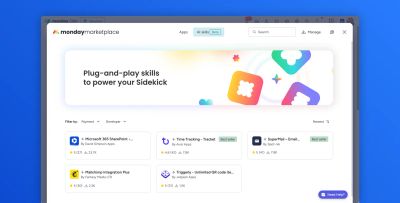
- Sidekick, a personal AI assistant that knows what you are working on and helps create boards, items and dashboards.
- Agents, which join the team as real users. You can tag them, chat with them, assign them work, put them in workflows and meetings, and give them feedback.
- Vibe, which turns a plain-language description into a working app that inherits monday.com's security and governance.
- Notetaker, which turns meetings into action items for people and agents.
He organized the design around "batteries included" value from day one: Sidekick for every employee out of the box, a library of pre-built agents based on industry best practices that can be used as is or customized, and a guided builder that lets non-technical people create agents and apps step by step. An agent library lets one person publish an agent they own so the whole company can use it, rather than rebuilding the same thing in every department.
Context, openness and trust
Lereya called context "king." Boards, docs, meetings, updates and even activity logs are natively available to monday.com's AI, so users do not have to re-explain their role, team and data in every prompt. Outside tools can be connected through integrations. Each interaction then improves the next one.
The platform is also open: customers can bring external agents such as Claude or ChatGPT into monday.com, where they follow the same rules as native agents. Because agents join as users, admins can apply role-based permissions and keep their work visible.
Lereya called trust "the number one feature" and described three decisions behind it:
- Whitelist data access. An agent can reach only what you explicitly grant, and external tools get granular permissions rather than blanket access. A Slack-posting agent does not need every channel.
- Human in the loop by default. Agents do the heavy lifting, but people approve what happens next.
- Spend control. Admins get a bird's-eye view of where credits are used and by whom, plus guardrails to avoid month-end surprises.
Platform scale and enterprise features
The platform section was a list of limits going up:
| Capability | What was announced | Status |
|---|---|---|
| monday data sets | New data entity holding up to 10 million items, 100x the current board limit | Presented as new |
| Organization hub | One place to view and control costs, AI spend, user management and permissions across one or multiple accounts | In development |
| Projects per portfolio | 5,000, up from 200 | Testing with selected customers; gradual rollout in the first half of 2027 |
| Boards per dashboard | 5,000, 100x today's limit | Same as above |
He also listed smaller releases (a native project intake flow and a sandbox for testing workflows) and upcoming work on private views, managed templates and a redesigned My Work. Lereya noted that monday.com was named a Gartner Leader in collaborative work management for the fourth time in a row.
One more thing: monday Harmony
The keynote closed with a new product, monday Harmony, a voice-AI agent for sales conversations. You describe what you need and get an agent "live in minutes" that knows your business and customers. The demo was an insurance sales call that qualified the lead, explained a coverage gap and booked an adviser appointment with a quote sent by SMS.
Monday.com says Harmony uses a dedicated model for each step of a conversation, can run a thousand calls at once, and learns from every call, proposing changes that take effect once a person approves them. More information is at harmony.ai. Lereya also pointed to monday CRM and monday service sessions later in the day.
What to take away
- The pitch has moved from managing work to doing it. monday.com now positions itself as the place where people and agents share boards, context and permissions.
- Governance is the selling point. Whitelisted access, approvals and spend controls were framed as the reason to run agents inside the platform rather than around it.
- Adoption help is now a product. Monday Frontier and the build-an-agent contest show the company treating implementation as the bottleneck.
- Watch the 2027 dates. The rebrand and the scale upgrades (5,000 projects per portfolio, 10-million-item data sets) are all slated for or tested toward the first half of 2027.
The keynote gave no exact release dates beyond those above, so check monday.com's release notes before planning around any of these features.
Automate your workflows with David Simpson Apps
Discover powerful apps and integrations for monday.com, Microsoft 365 and more. Streamline processes, embed analytics, and boost collaboration.
View our apps on the monday marketplace