Features
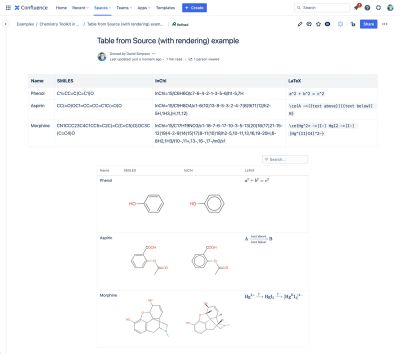
The Table from Source (with Rendering) macro is an advanced formatting macro for Confluence.
It has the following features:
- Takes data from any macro source which emits data in
table-adfformat, such as a native Confluence table - Displays a table based on the source data it receives from a source macro or table
- Filter/search field for quick access to data
- Sort the table by clicking on the header cells
- Wrap cell content, or not
- Renders the following LaTeX notation to mathematical & chemical equations - where the table header is named
LaTeX(with this exact capitalisation) - SMILES format to 2D chemical structures - where the table header is named
SMILES - InChI format to 2D chemical structures - where the table header is named
InChI(with this exact capitalisation) - URLs and email addresses are hyperlinked
- Links in markup language are hyperlinked e.g.
[David Simpson Apps website](https://www.dsapps.dev/)are rendered in HTML
Horizontal scrollbars for large content with shaded indicators to suggest you can scroll horizontally
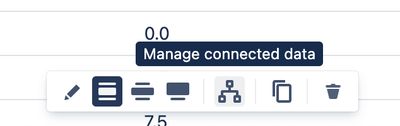
Tables can be connected to Charts using the Manage connected data context menu item:
How to use
To use this macro, you need a source of data, such as a Confluence table.
In the Confluence editor, add a Confluence table and add some SMILES, InChI, and/or LaTeX to the table cells.
Make sure to label your column headers with SMILES, InChI, and LaTeX if you wish to use the rendering capabilities.
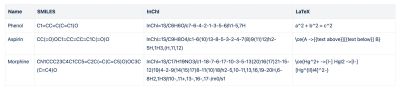
Your table should look something like this:
| Name | SMILES | InChI | LaTeX |
|---|---|---|---|
| Phenol | C1=CC=C(C=C1)O | InChI=1S/C6H6O/c7-6-4-2-1-3-5-6/h1-5,7H | a^2 + b^2 = c^2 |
| Aspirin | CC(=O)OC1=CC=CC=C1C(=O)O | InChI=1S/C9H8O4/c1-6(10)13-8-5-3-2-4-7(8)9(11)12/h2-5H,1H3,(H,11,12) | \ce{A ->[{text above}][{text below}] B} |
| Morphine | CN1CCC23C4C1CC5=C2C(=C(C=C5)O)OC3C(C=C4)O | InChI=1S/C17H19NO3/c1-18-7-6-17-10-3-5-13(20)16(17)21-15-12(19)4-2-9(14(15)17)8-11(10)18/h2-5,10-11,13,16,19-20H,6-8H2,1H3/t10-,11+,13-,16-,17-/m0/s1 | \ce{Hg^2+ ->[I-] HgI2 ->[I-] [Hg^{II}I4]^2-} |
Click in a table cell and then click on the “Manage connected data“ icon:
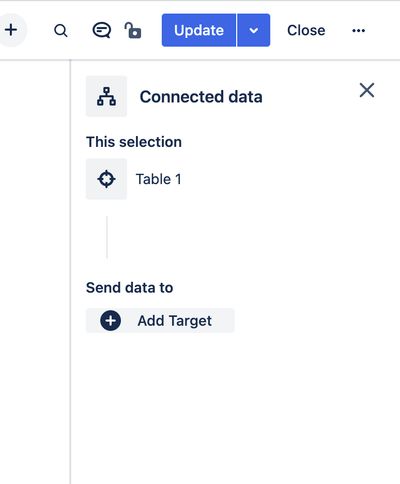
In the macro properties panel, select Add Target:
Then select “Table from Source (with Rendering)”:
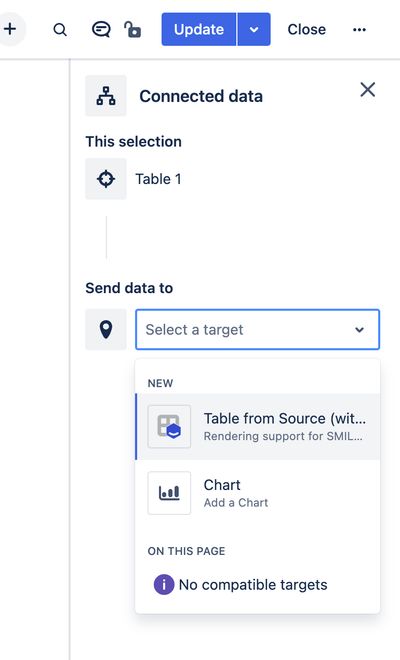
A new macro will appear below the existing table. Click on the macro, then the Edit icon:
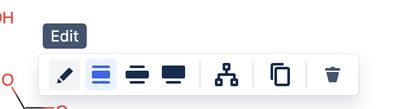
The macro properties panel will appear.
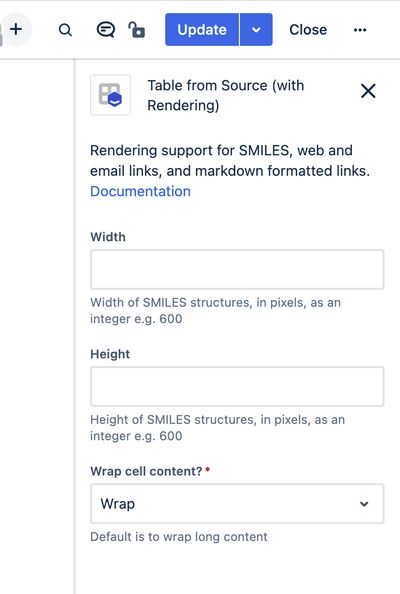
Add the width and height for any rendered SMILES structures, or leave for the default size.
Choose whether or not to wrap the cell content.
Save the Confluence page and the table will be rendered: